
For most of House of the Dragon, I’ve struggled to take Aegon II seriously as a king.
He had the crown.
He sat on the Iron Throne.
People bowed when he entered a room.
But none of those things actually made him a king.
What he lacked wasn’t authority.
It was responsibility.
Every setback was somebody else’s fault. Every mistake had an excuse attached to it. Whenever things went wrong, Aegon always seemed to find someone else to blame, whether it was Aemond, his upbringing or simply bad luck.
A few weeks ago I wrote about the conversation between Larys Strong and Aegon, arguing that it was the first time anyone had forced him to confront that reality.
Now, after Episode 7, I think we’ve finally seen the payoff.
Below is my video covering why I think Episode 7 marks the moment Aegon II truly became king.
A Crown Doesn’t Make a King
One thing I’ve always loved about fantasy is that it constantly reminds us leadership isn’t something you inherit.
You can inherit a title.
You can inherit a castle.
You can inherit an army.
But you can’t inherit respect.
That has to be earned.
For most of this series, Aegon wanted all the rewards of being king without accepting the responsibility that came with it.
He enjoyed the privilege.
He hated the burden.
That’s what made him feel so immature compared to characters like Viserys or even Aemond.
He wasn’t ruling.
He was reacting.
The Choice That Changed Everything
Episode 7 puts Aegon in a situation where nobody can make the decision for him.
Larys offers him escape.
A new identity.
A fresh start across the Narrow Sea.
Forget Westeros.
Forget the throne.
Forget everything.
Tyland Lannister, meanwhile, argues almost the complete opposite.
For much of the episode I wasn’t entirely sure whether Tyland genuinely believed in Aegon or whether he was simply backing the side that offered him the best chance of keeping his own influence.
Then something changes.
As refugees flee Rhaenyra’s advancing army and reports of town after town falling reach them, Aegon is forced to answer a question he’s spent three seasons avoiding.
Do I keep running?
Or do I finally accept what being king actually means?
That’s the moment the character changes.
Not because he suddenly becomes fearless.
Because he stops making excuses.
Larys Knows His Work Is Finished
One detail I absolutely loved was Larys Strong’s reaction.
Earlier in the season, Larys finally confronted Aegon with some brutally honest truths about the life he’d chosen for himself.
This time, he doesn’t try to manipulate him.
He doesn’t whisper another clever strategy.
He doesn’t try to steer him towards safety.
He simply accepts Aegon’s decision.
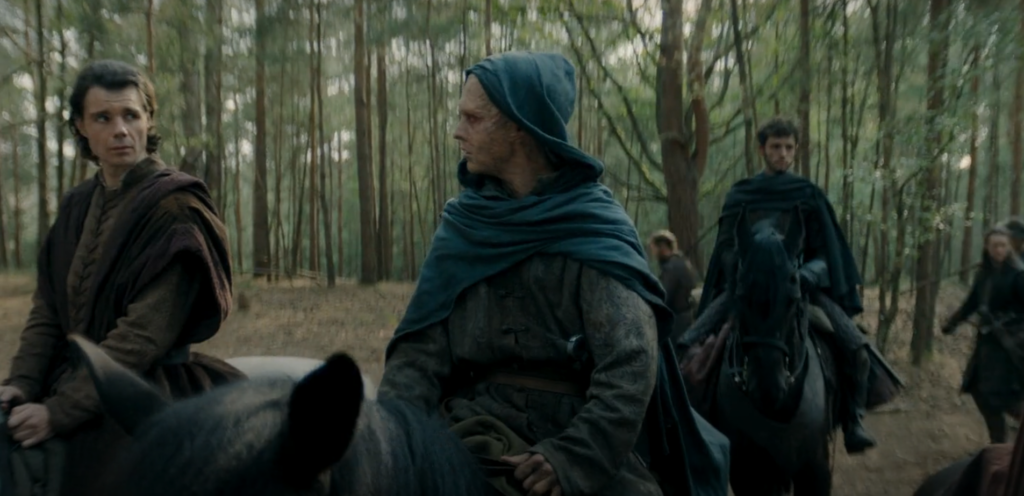
It’s almost as though he recognises something fundamental has shifted.
For the first time, Aegon is making a decision entirely on his own.
Larys no longer has a king he can influence.
He has a king who’s finally decided what kind of man he wants to be.
That silence says just as much as any speech could.
Courage Isn’t Believing You’ll Win
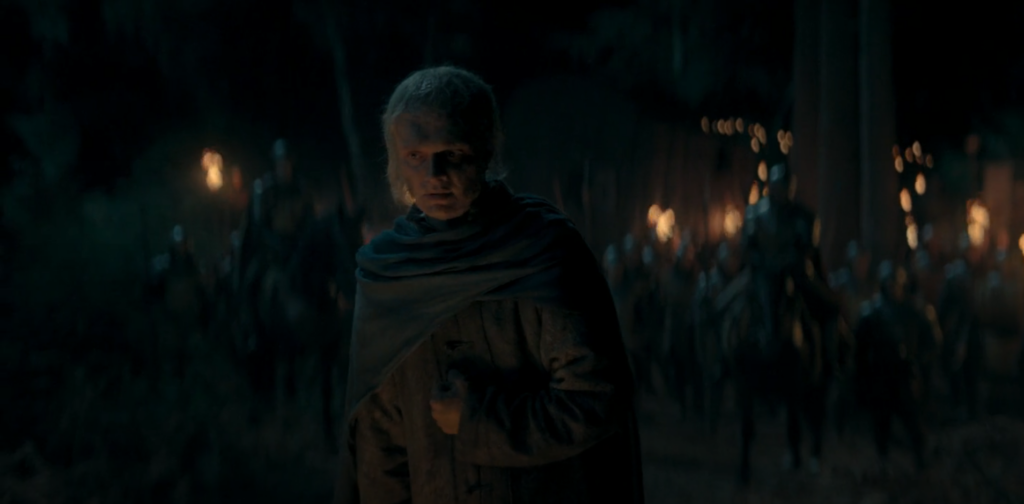
One of my favourite moments in the entire episode comes when Aegon and Tyland stand before an advancing army.
He’s completely outnumbered.
He’s burned.
Scarred.
Barely able to walk.
He’s not some legendary warrior destined to cut through hundreds of enemies.
If anything, he looks like a man who’s already lost.
The old Aegon would probably have found another excuse.
Another escape.
Another reason why someone else should solve the problem.
Instead, he reaches for his sword.
Not because he believes he can win.
Because he’s finally accepted that some responsibilities don’t disappear simply because they’re difficult.
Then he begins praying to the Seven.
It’s a remarkably quiet scene, but that’s exactly why it works.
His conviction feels genuine for the first time in the series.
That’s courage.
Not confidence.
Conviction.
Sunfyre Doesn’t Save the Moment
Then comes the scene that genuinely gave me goosebumps.
Sunfyre descends behind Aegon.
I absolutely loved this moment, but probably not for the reason many people did.
The dragon isn’t what makes the scene powerful.
Aegon is.
If Sunfyre had appeared five minutes earlier, none of this would have mattered.
Aegon would never have been forced to confront the choice between running away and standing his ground.
He wouldn’t have earned his transformation.
Instead, the dragon arrives only after Aegon has already made peace with the possibility of dying.
That’s why the moment works.
Sunfyre doesn’t create Aegon’s courage.
He rewards it.

It’s almost poetic.
Two broken creatures.
Both scarred.
Both dismissed.
Both believed to be finished.
Finding each other again at exactly the moment they needed it most.
It’s one of the most cinematic scenes House of the Dragon has produced.
Growth Doesn’t Require Perfection
What I appreciate most is that the writers don’t suddenly pretend Aegon has become a perfect king.
He hasn’t.
He’s still impulsive.
Still deeply flawed.
He’s almost certainly going to make terrible decisions again.
But that’s what makes his development interesting.
Character growth doesn’t mean becoming flawless overnight.
It means making one better decision than you would have made yesterday.
Episode 7 feels like the first time Aegon chooses responsibility over self-preservation.
That’s genuine growth.
Why This Arc Has Started Winning Me Over
When House of the Dragon began, I never imagined Aegon would become one of the characters I was most interested in following.
Yet here we are.
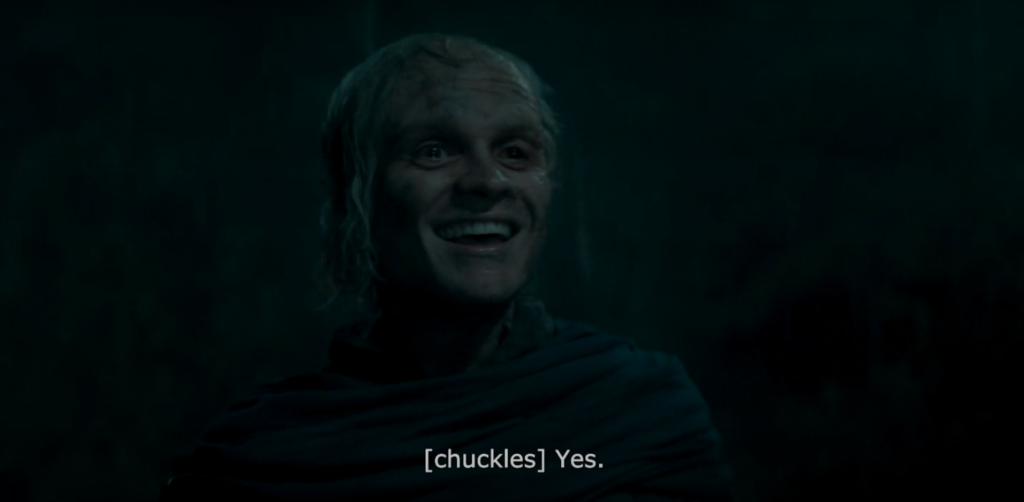
Not because he’s suddenly become heroic.
But because he’s finally becoming believable.
Watching a deeply flawed person slowly accept responsibility is often far more compelling than watching someone who was noble from the beginning.
That’s why this episode stayed with me.
It wasn’t really about dragons.
It wasn’t even about the battle.
It was about a man finally becoming worthy of the title he’d held all along.
Final Thoughts
House of the Dragon has always been at its best when it focuses on its characters rather than its spectacle.
Episode 7 is another perfect example of that.
The dragons are incredible.
The battles are spectacular.
But the moment I’ll remember isn’t Sunfyre’s arrival.
It’s everything that happened before it.
Because for the first time since the series began, Aegon II didn’t act like a frightened prince pretending to be king.
He acted like a king who finally understood what the crown was asking of him.
And that’s a transformation worth earning.